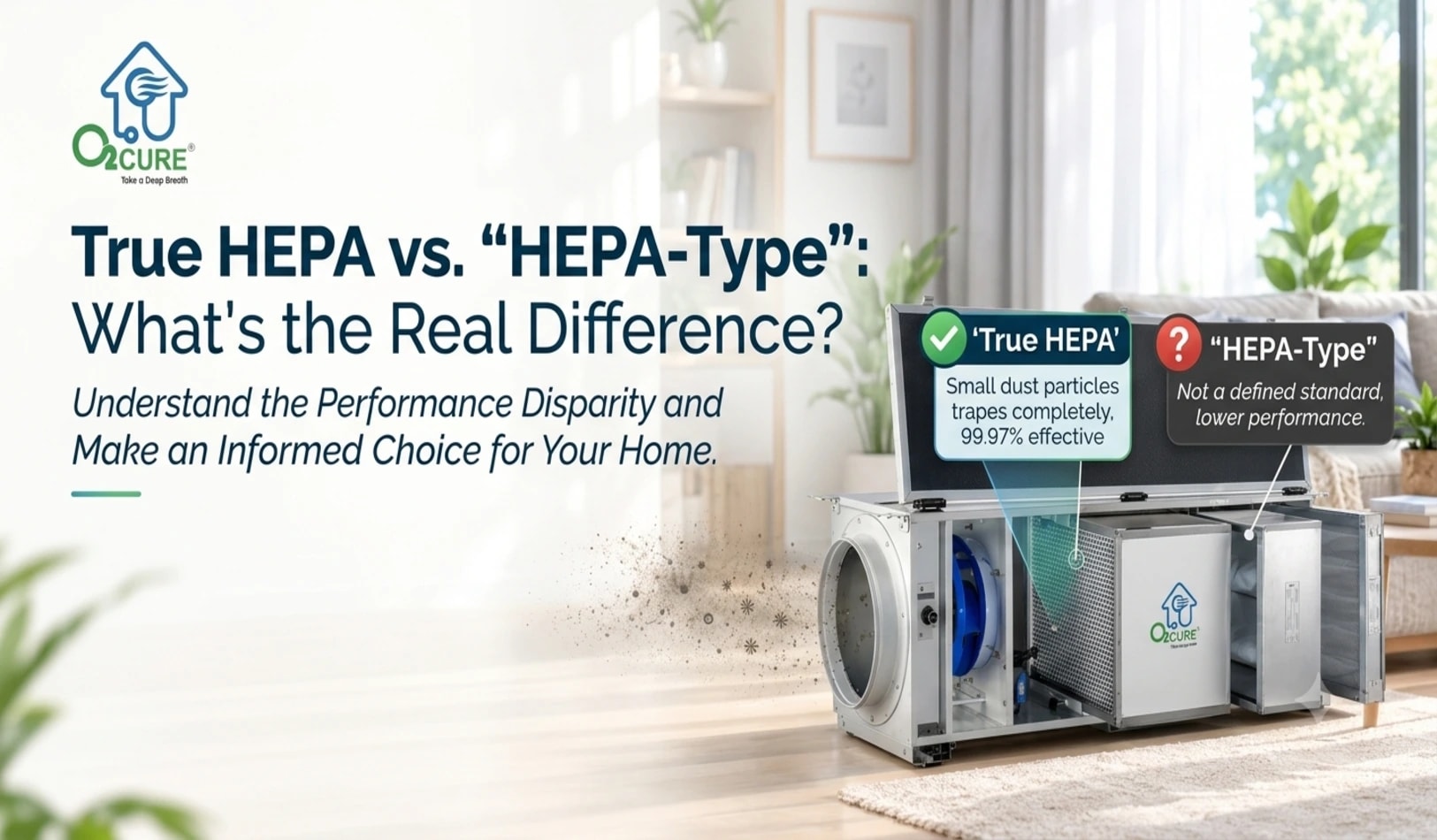
Fine particles can affect how clean indoor air feels, especially when dust, pollen, smoke, and other small particles remain suspended for long periods. The filter inside an air purifier plays a key role in controlling these particles. However, not every filter described as “HEPA-Type” offers the same level of filtration as a True HEPA filter. Understanding the difference helps you choose a unit based on filter design, particle capture, airflow, and the needs of each room.
What Does True HEPA Mean?
True HEPA refers to a defined type of high-efficiency particulate filter. Its dense filter media is designed to capture very small airborne particles as air passes through it.
The filter works through several particle capture methods. Larger particles can become trapped within the filter fibers. Smaller particles can collide with fibers or move along airflow paths before being captured.
A True HEPA filter is designed around tested filtration performance rather than a general marketing term. This makes the filter specification important when comparing different air cleaning products.
For a home setup, a hepa home air purifier with a suitable True HEPA filter can help reduce airborne particulate matter. The actual result also depends on airflow, room size, filter condition, and how often the unit operates.
What Is a HEPA-Type Filter?
“HEPA-Type” is a broader product term. It usually describes a filter designed to provide high particle filtration but does not carry the same defined performance claim as a True HEPA filter.
The term can cover different filter designs and materials. Their particle capture rates may vary between products. This means you should not assume that a HEPA-Type filter performs exactly like a True HEPA filter.
This distinction matters when comparing an air cleaner purifier for a room where fine particle control is a key concern. Looking beyond the filter name can give you a clearer idea of what the unit actually offers.
True HEPA vs. HEPA-Type: Key Differences
The main difference lies in how clearly the filter's performance is defined. True HEPA refers to a recognized high-efficiency filter category, while HEPA-Type is a broader product description.
Consider these points when comparing the two:
- Filter standard: True HEPA has a defined filtration performance target. HEPA-Type does not have one universal standard.
- Particle capture: True HEPA filters are designed for high capture of fine airborne particles.
- Product comparison: True HEPA specifications make it easier to compare filtration claims.
- Filter design: Both may use dense filter media, but their construction and performance can differ.
- Use case: Rooms with higher particle loads may benefit from a unit built around a well-specified HEPA filter.
- Maintenance: Both filter types need timely replacement to maintain useful airflow and filtration.
The filter alone does not determine an air purifier's overall performance. Clean air delivery, airflow design, room size, operating time, and filter loading also matter.
Why Airflow Matters as Much as the Filter
A highly efficient filter cannot clean room air effectively if the unit moves too little air. Air must pass through the filter before particles can be captured.
This makes airflow an important part of choosing hepa air cleaners for home use. A suitable unit should match the room and expected particle load.
Consider a bedroom, living room, study, or workspace. Each room can have different air volume and usage patterns. A unit with suitable airflow can circulate more room air through its filter during operation.
Filter life also affects performance. As particles build up, airflow can fall if the filter becomes heavily loaded. Regular filter checks help maintain the intended operation of the unit.
Where Can True HEPA Air Purification Be Useful?
Different rooms can create different air cleaning needs. A bedroom may need quiet, regular operation during sleep hours. A living room may require stronger circulation because of its larger space and longer daily use.
A hepa home air purifier can also be useful in spaces where dust and fine particles are frequent concerns. The right model should be selected according to room size, airflow requirements, and operating conditions.
Useful applications include:
- Bedrooms where regular air circulation is needed.
- Living spaces with frequent daily activity.
- Work areas where airborne dust can accumulate.
- Rooms where smoke or fine particles are a concern.
- Shared indoor spaces that need regular air cleaning.
The goal is not simply to choose the strongest filter. It is to choose a complete air cleaning system that fits the room.
What Should You Check Before Buying?
Filter terminology should be only one part of your buying decision. Start by checking the filter type and the performance information provided for the model.
Then consider airflow and coverage. A unit should be able to circulate enough air for the intended room. Noise levels can also matter if the purifier will run for long periods.
Check the replacement filter details as well. A filter that is difficult to replace or maintain can affect long-term use.
For hepa air cleaners for home, also consider:
- Filter stages and their purpose.
- Airflow or clean air performance information.
- Recommended room size.
- Filter replacement requirements.
- Operating noise.
- Energy use.
- Controls and operating modes.
- Availability of replacement filters.
These details help you judge the complete system instead of relying on the word “HEPA” alone.
Choose O2 Cure for Purpose-Built Air Cleaning
At O2 Cure, we focus on air purification systems designed to support cleaner indoor air through thoughtful filtration and airflow. Our range includes models suited to different room sizes and usage needs.
Our solutions are designed around practical indoor air cleaning needs, with attention to filtration, airflow, operation, and ease of use.
Explore O2 Cure Models
- O2 Cure Air Purifiers: Designed for everyday indoor air cleaning with filtration systems built for fine airborne particles.
- O2 Cure Room Air Purifiers: Suitable for personal spaces where consistent air circulation and filtration are important.
- O2 Cure Larger-Room Models: Built for spaces that require greater airflow and wider air circulation.
- O2 Cure Compact Models: Useful where space is limited and a smaller air cleaning unit is preferred.
When selecting a model, check its stated coverage, airflow, filter configuration, operating modes, and replacement filter requirements. These specifications help you match our products with your actual room and usage needs.
Our air purification range can help you make a more informed choice based on how your indoor space is used. Rather than choosing only by filter terminology, consider the complete filtration and airflow system.
Contact Us
Ready to find the right air cleaning solution for your space? Visit our official O2 Cure website to explore our air purifier models and specifications. We can help you understand filter options, airflow needs, and model features. Choose our solutions with confidence and take the next step toward cleaner indoor air.
Frequently Asked Questions
1. Is True HEPA better than HEPA-Type?
True HEPA provides a defined high-efficiency filtration standard, while HEPA-Type is a broader term. Actual performance depends on the filter design and complete purifier system.
2. Can a HEPA-Type filter remove fine particles?
A HEPA-Type filter can capture fine particles, but its performance can vary between products. Check the manufacturer's stated filtration specifications before making your choice.
3. Does a True HEPA filter remove all indoor pollutants?
No filter removes every indoor pollutant. True HEPA mainly targets airborne particles, while gases and odors require other filtration methods within a purifier.
4. How often should a HEPA filter be replaced?
Replacement timing depends on usage, particle levels, airflow, and the manufacturer's instructions. Check the filter regularly and replace it when recommended for proper operation.
5. What should I consider besides the HEPA filter?
Consider room size, airflow, filter stages, noise, operating modes, maintenance, energy use, and replacement filter availability before selecting an air purification system.