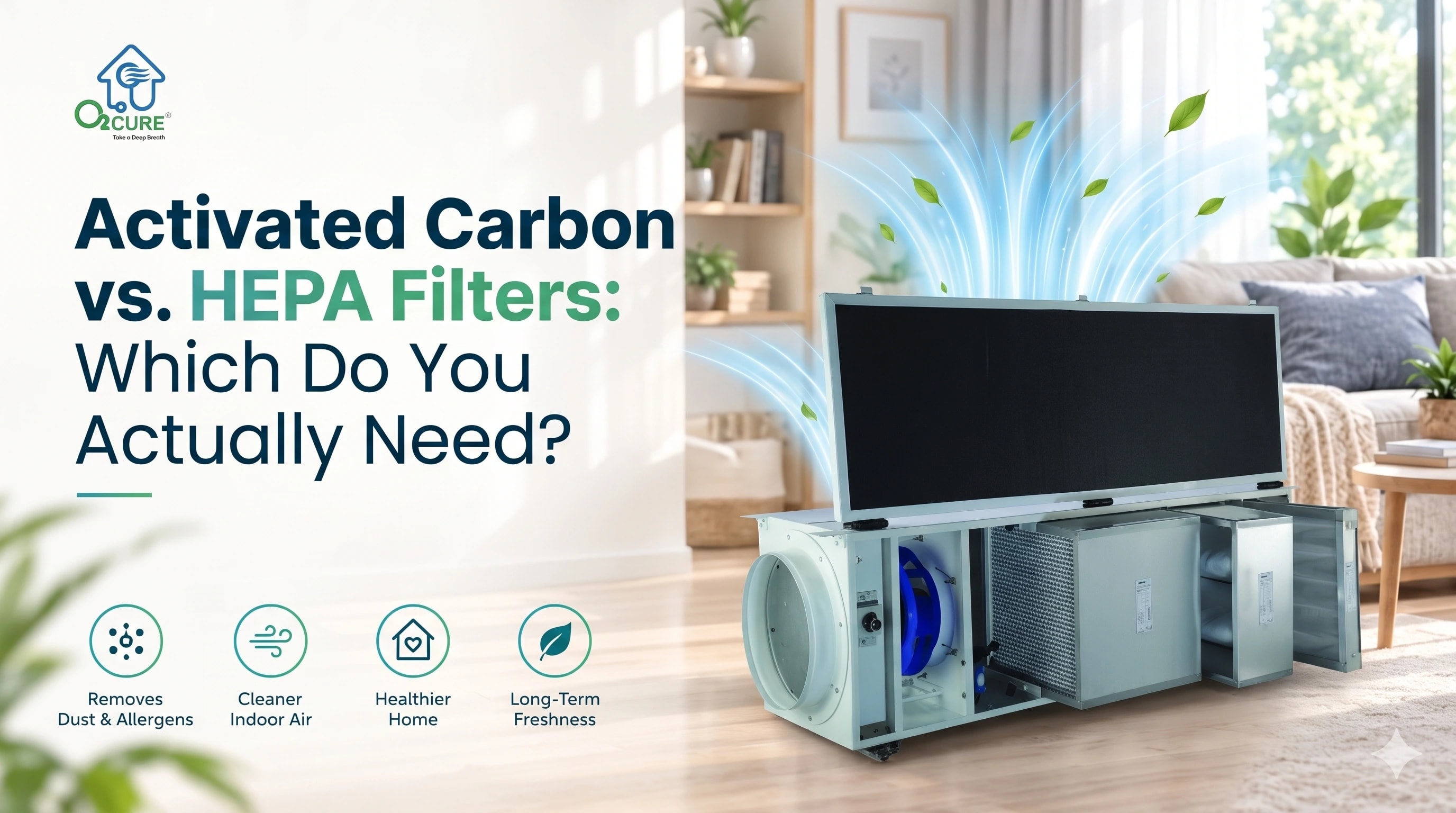
When choosing an air purifier, two terms often come up: HEPA and activated carbon. Both are widely used in air purification, but they do very different jobs. HEPA filters are designed primarily to capture airborne particles, while activated carbon helps address certain gases, VOCs, and odours. If you are comparing options for your home, understanding these differences can help you choose the air cleaner suited to your indoor air needs.
So, which one do you actually need? The answer depends on what is affecting your indoor air. In many cases, using both technologies together provides broader coverage than relying on either one alone.
What Does a HEPA Filter Remove?
HEPA stands for High-Efficiency Particulate Air. A properly specified HEPA filter can capture at least 99.97% of particles at 0.3 microns under the relevant test conditions. It captures particles as air passes through its dense fibre structure, using mechanisms including impaction, interception, and diffusion.
This makes HEPA filtration useful for reducing particulate pollutants such as PM2.5, dust, pollen, pet dander, mould spores, and other airborne particles. HEPA filters are available in different efficiency grades. Under the EN 1822 classification, H13 filters offer at least 99.95% overall efficiency, while H14 filters offer at least 99.995%. Older labels such as H10, H11, and H12 may also appear, while H1, H2, and H3 are not standard grades under this classification.
For households mainly concerned about dust, allergens, or fine particulate pollution, a HEPA home air purifier can therefore be an important part of an indoor air-quality strategy. However, HEPA filters are not designed to remove gases and most odours.
When comparing HEPA air cleaners for home, look beyond the word "HEPA." Filter grade, airflow, room coverage, system sealing, and maintenance can all affect real-world performance.
What Does Activated Carbon Do?
Activated carbon works completely differently from a standard particle filter. Instead of catching physical dust in a web of fibres, it relies on adsorption, basically pulling specific gas molecules and smelly compounds out of the air and trapping them inside millions of tiny microscopic pores across its surface.
It’s great at soaking up things like everyday VOCs, lingering smoke smells, and persistent cooking odours. That said, carbon isn’t a magical sponge that catches every single gas out there. How well it actually works comes down to the quality and physical weight of the carbon used, air contact time, local pollution levels, and the overall design of the filter box.
This is exactly why those paper-thin, carbon-coated sheets you see crammed into cheap, compact purifiers shouldn't be confused with a real, heavy-duty carbon filter bed.
If you're constantly dealing with greasy kitchen smells, chemical off-gassing from new furniture, paint fumes, or stale smoke, having proper carbon filtration is non-negotiable. Finding the best air cleaner for your home ultimately means matching the machine to the specific pollutants you're trying to clear, rather than just staring at the particle rating on the box.
HEPA vs. Activated Carbon: What Is the Difference?
The simplest way to understand the difference is to look at what each technology targets.
| Feature | HEPA Filter | Activated Carbon |
|---|---|---|
| Main purpose | Particle filtration | Gas and odour control |
| Targets | PM2.5, dust, pollen, dander and other particles | Certain VOCs, gases and odours |
| Main mechanism | Mechanical filtration | Adsorption |
| Removes gases? | No | Certain gases and compounds |
| Removes particles? | Yes | Not its primary function |
| Best suited for | Dust and particulate pollution | Odours and gaseous pollutants |
The two technologies are therefore complementary rather than interchangeable.
Do You Need HEPA, Activated Carbon, or Both?
Start by looking at what’s actually floating around in your living space. If you live right near a noisy, busy road or in a neighbourhood hit by high smog levels, trapping fine particles is going to be your top concern. On the flip side, if your kitchen constantly fills with heavy cooking fumes, strong pet smells, or chemical VOCs, gas-phase filtration needs serious attention too.
For most households, running both together is just plain common sense. A HEPA home air purifier built with a heavy-duty activated carbon stage tackles solid particles and airborne gases at the same time, giving your unit a much wider cleanup range.
This combo really shines when your indoor air gets hit by multiple pollution sources all at once. Outdoor dust and PM2.5 seep in through open doors, while cooking, cleaning sprays, new furniture, and daily life dump fumes into the room.
So when you're shopping around for HEPA air cleaners for home, look at the whole filter setup as a team rather than judging the HEPA filter by itself in a vacuum.
What Else Should You Check Before Choosing a Purifier?
Filter media is really only half the story here. Total airflow and Clean Air Delivery Rate (CADR) are just as critical, simply because even the best filter can't clean your air if the fan can't push enough volume through the room.
Space dimensions, high ceilings, family count, active pollution spots, window ventilation, fan noise, filter swap intervals, and power draw all play a huge role in what makes a unit right for you.
You also want to match the machine to where it’s actually sitting, like a quiet bedroom, busy living room, office, medical clinic, or large open space. The best air cleaner for a cosy studio apartment will completely struggle in a big commercial space because air movement demands are night and day.
When dealing with tougher environments, advanced multi-stage tech becomes a big deal. O2Cure's TriCure™ setup, for instance, is built specifically to target three distinct pollutant groups: airborne particles, microbial bugs, and chemical gases or odours.
O2Cure: Air Purification Designed Around Your Environment
At O2Cure, we design air purification systems around the specific needs of your space rather than treating every environment the same way. Our TriCure™ Technology addresses particulate matter, microbial pathogens, and gases and odours through an integrated purification architecture. We provide solutions for residential, commercial, industrial, healthcare, education, and data-centre environments, supported by site-specific assessments and air-quality engineering. Our specialists can evaluate your space, occupancy, and pollution load before recommending a suitable purification approach. We also provide real-time air-quality monitoring solutions and full-environment purification design. With 700+ enterprise deployments across India, we focus on selecting and sizing purification systems according to real-world indoor air requirements.
Frequently Asked Questions
1. Is HEPA better than activated carbon?
Neither is universally better. HEPA targets particles, while activated carbon addresses certain gases, VOCs, and odours.
2. Can activated carbon filters remove dust?
No, activated carbon primarily adsorbs certain gases and odours rather than capturing airborne particles like HEPA filters.
3. Does HEPA remove odours from indoor air?
HEPA filters primarily capture particles, so they generally require activated carbon to address gaseous odours effectively.
4. Can I use HEPA and activated carbon together?
Yes, combining both technologies can provide broader coverage against particulate pollutants, certain gases, VOCs, and odours.
5. How do I choose between HEPA and activated carbon?
Consider your main indoor pollutants, including particles, allergens, odours, VOCs, and gases, before selecting suitable filtration technology.