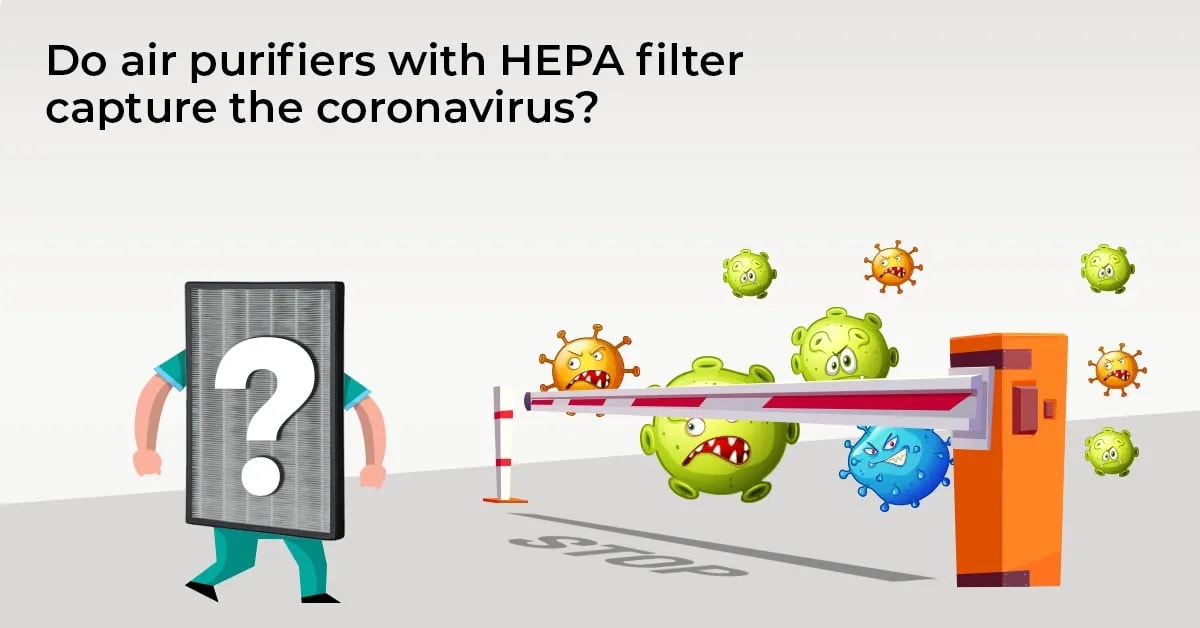
HEPA stands for High-Efficiency Particulate Air. A True HEPA filter is defined by its ability to capture 99.97% of particles at 0.3 microns in diameter — the most penetrating particle size (MPPS) for fibrous filter media. At sizes both larger and smaller than 0.3 microns, filtration efficiency is actually higher.
The range of particles HEPA captures includes: PM2.5 and PM10 (fine and coarse particulate matter), pollen (10–100 microns), dust mite allergens (1–10 microns), pet dander (2.5–10 microns), mold spores (1–20 microns), most bacteria (0.5–5 microns), and larger aerosol droplets.
HEPA works through four mechanisms: impaction (large particles collide with fibers and stick), interception (medium particles follow airflow but touch a fiber), diffusion (Brownian motion causes sub-0.1 micron particles to collide with fibers), and electrostatic attraction.
The limitations of HEPA are equally important to understand: HEPA alone does not remove gaseous pollutants, VOCs, odors or very small molecules (below approximately 0.01 microns). For these, activated carbon filtration is required as a complementary stage.
For comprehensive indoor air purification, a multi-stage system combining True HEPA, activated carbon and an advanced oxidation stage (such as PHI technology) addresses the full spectrum of indoor air pollutants — particulate, microbial and gaseous.