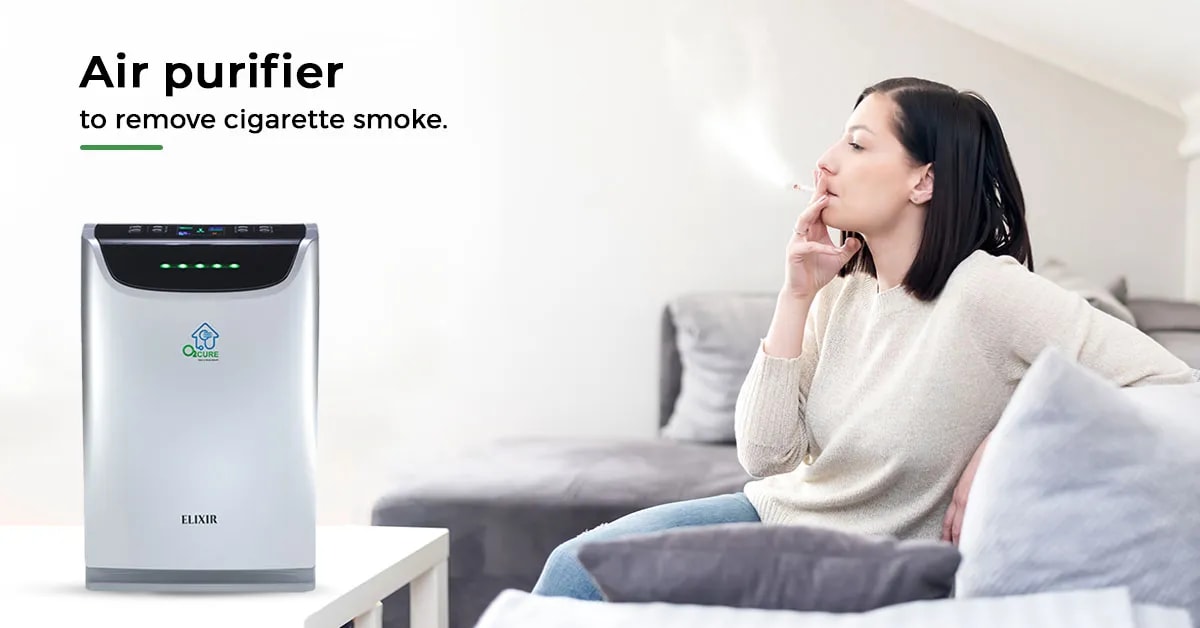
Cigarette smoke is one of the most challenging indoor air quality problems to address. It is a complex mixture of over 7,000 chemicals, many of which are toxic, and it consists of both particulate matter and gaseous compounds.
An effective air purifier for cigarette smoke must address both components: a True HEPA filter to capture particulate matter (tar, fine particles) and an activated carbon filter with sufficient carbon mass to adsorb the gaseous chemicals (formaldehyde, benzene, acrolein, and hundreds of other VOCs).
The American Society of Heating, Refrigerating and Air-Conditioning Engineers (ASHRAE) recommends a minimum of 6 air changes per hour (ACH) for spaces where smoking occurs. For a 200 sq ft room with a 9 ft ceiling, this requires a purifier with a minimum CADR of approximately 270 cfm.
Ionizers alone are not effective against cigarette smoke — they can temporarily reduce particle count but do not remove the gaseous chemicals that cause the lingering odor and health effects.
For spaces where smoking is a regular occurrence, the activated carbon filter should be replaced more frequently than the standard schedule — approximately every 3–4 months rather than every 6–12 months, depending on smoking frequency.